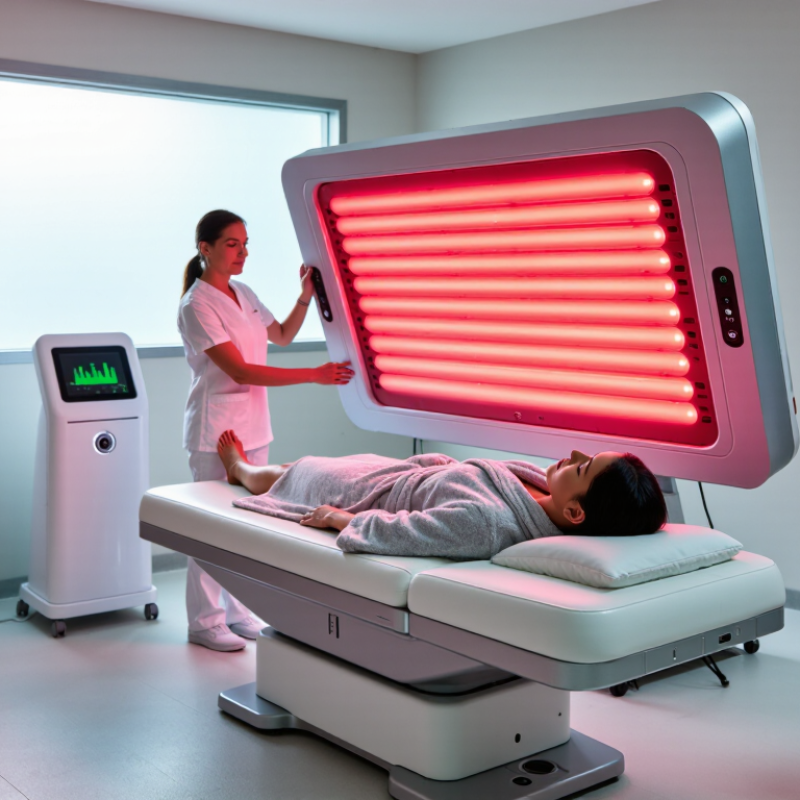
The 2026 Best Red Light Therapy Spa Buying Guide begins with a practical question: what should a spa actually buy?
The global wellness economy reached $6.3 trillion in 2023, according to the Global Wellness Institute’s 2024 Global Wellness Economy Monitor. Its forecast suggests continued expansion through 2028. This growth creates opportunity, but market enthusiasm can also hide weak specifications and exaggerated claims. Market research firms report strong growth for light therapy, although their estimates differ because definitions and data sources vary. That difference deserves attention.
A professional Red Light Therapy Spa should evaluate more than appearance or advertised wattage. Treatment wavelength, irradiance, exposure time, cooling, electrical certification, cleaning access, and client positioning all affect daily performance. A bright panel is not automatically an effective panel.
Safety matters.
The U.S. Food and Drug Administration distinguishes medical devices from general wellness products. Buyers should verify intended use, regulatory status, labeling, and professional guidance in their operating region. ISO 13485 certification may indicate a controlled medical-device quality system, but it does not replace product-specific verification.
This guide examines equipment selection through an operator’s lens. It considers room size, appointment turnover, staff training, maintenance costs, warranty terms, and realistic return on investment. A device that saves five minutes per session may matter more than impressive marketing language.
No buying checklist is perfect. Spa owners should question uncertain claims, request test reports, and compare independent evidence before signing a purchase agreement. The best decision is rarely the most glamorous one. It is the one that remains safe, measurable, serviceable, and credible after hundreds of treatments.
A red light therapy spa is a room or booth using LED panels to deliver red and near-infrared light. Red wavelengths commonly range from 630–660 nanometers, while near-infrared light often reaches 810–850 nanometers. These wavelengths are non-ionizing, so they do not tan or burn skin like ultraviolet radiation.
The proposed mechanism is photobiomodulation. Light may interact with mitochondrial cytochrome c oxidase, supporting cellular energy production and local circulation. Evidence remains uneven. A 2023 review in Photobiomodulation, Photomedicine, and Laser Surgery reported potential benefits for skin appearance and recovery, but noted differences in dose, device quality, and study design. The Global Wellness Institute valued the global wellness economy at about 6.3 trillion dollars in 2023, showing strong consumer interest, not proof that every spa treatment works.
Tips: Ask for wavelength, irradiance, treatment time, and eye-protection guidance. A professional operator should explain contraindications and avoid promising instant results. Clean surfaces matter, too. Start conservatively. Skin responses vary. I would question any provider hiding technical specifications. Follow-up photos under identical lighting can help, although they are not clinical measurements. More research is still needed, especially for long-term use and different skin types.
How it works: Red and near-infrared light emit non-ionizing photons that can be absorbed by cellular components involved in energy production and signaling. Red light is commonly used around 630–660 nm, while near-infrared light commonly ranges from approximately 810–850 nm.
This chart shows the photon energy associated with representative wavelengths used in photobiomodulation research. Photon energy decreases as wavelength increases; lower photon energy does not mean lower treatment value, because biological effects also depend on irradiance, exposure time, treatment distance, coverage, and individual response.
Buying considerations: Check the published wavelength range, measured irradiance, treatment-area coverage, timer controls, ventilation, cleaning procedures, user instructions, and appropriate eye-protection guidance. The displayed photon energy is calculated using E = hc/λ, where h is Planck’s constant and c is the speed of light.
2026 Best Red Light Therapy Spa Buying Guide
Red light therapy spa treatments use low-intensity red and near-infrared light. They may support skin appearance, temporary pain relief, and muscle recovery. The evidence is promising, not tidy. A 2023 review in Photobiomodulation, Photomedicine, and Laser Surgery found potential benefits for skin repair and pain management, but study methods varied widely.
Common spa uses include facial treatments, post-exercise recovery, and localized joint comfort. Clients may notice warmer skin, mild relaxation, or a refreshed appearance after a session. Results usually require repeated treatments. They also depend on wavelength, light intensity, session distance, and treatment time. More light is not automatically better.
The International Spa Association reported that U.S. spa revenue reached about 21.3 billion dollars in 2023. That growth encourages more facilities to add light-based services. Buyers should request measured irradiance, wavelength details, maintenance records, and written eye-protection procedures. A credible operator explains limitations clearly. Be cautious when staff promise fat loss, permanent pain removal, or guaranteed medical results. Those claims exceed current evidence. People using photosensitizing medication or managing eye conditions should ask a qualified clinician first. Skin can look calm after treatment, yet deeper benefits remain difficult to measure. I would record session dates, exposure settings, and skin reactions before judging value. Spa menus rarely make that comparison easy.
| Buying or Treatment Dimension | Evidence-Based Specifications or Typical Range | Key Benefits and Common Uses | What to Check Before Purchase or Treatment | Safety and Practical Notes |
|---|---|---|---|---|
| Primary Light Spectrum | Red: approximately 620–700 nm Near-infrared: approximately 700–1,000 nm | Red light is commonly selected for surface-level skin applications, while near-infrared light is used when greater tissue penetration is desired. | Confirm the actual wavelength range in the technical specifications rather than relying only on terms such as “red light” or “full spectrum.” | Near-infrared light is invisible or nearly invisible, so the presence of bright visible red light does not confirm near-infrared output. |
| Common Wavelength Choices | Approximately 630–660 nm for visible red light and 810–850 nm for near-infrared light are frequently used in photobiomodulation equipment. | Often used in skin-focused protocols, general wellness programs, muscle recovery routines, and localized comfort applications. | Look for independent wavelength testing, clearly stated peak wavelengths, and consistent coverage across the treatment area. | A wider wavelength range is not automatically better; suitability depends on the intended use, dose, coverage, and treatment schedule. |
| Irradiance | Irradiance is the optical power delivered per unit area, normally expressed as mW/cm². Consumer and professional devices can vary substantially. | Helps determine how quickly a target dose can be delivered and supports more consistent treatment planning. | Verify whether the stated irradiance was measured at the recommended treatment distance and whether it applies to the whole treatment area. | Higher irradiance does not necessarily produce better results. Excessive exposure can increase heat, discomfort, or skin irritation. |
| Energy Dose | Fluence is measured in J/cm². A basic calculation is: dose = irradiance × time. For example, 50 mW/cm² for 10 minutes delivers approximately 30 J/cm². | Provides a more useful basis for comparing treatment protocols than session time alone. | Check whether the spa or device provides a recommended dose range, session duration, and treatment frequency for the intended application. | Published protocols differ by target tissue and objective. Start conservatively and follow qualified professional guidance when available. |
| Treatment Coverage | Options include localized panels, facial units, full-body panels, and enclosed systems. Coverage may range from a small body region to most of the body. | Larger coverage can make full-body wellness sessions more convenient, while localized systems may be easier to position accurately. | Compare illuminated area, number of treatment positions, adjustable height, distance from the light source, and session capacity. | Uniform coverage is important. Hot spots, large untreated gaps, or inconsistent positioning may reduce dose consistency. |
| Skin Appearance and Texture | Red light therapy is commonly used as a non-invasive cosmetic treatment intended to support the appearance of skin firmness, texture, and overall tone. | Common spa uses include fine-line appearance, mild uneven tone, dull-looking skin, and general skin revitalization. | Ask whether the protocol is designed for cosmetic maintenance, whether photos are taken under consistent lighting, and what time frame is realistic. | Results vary. Red light therapy should not be marketed as a guaranteed wrinkle remover or replacement for clinically indicated dermatological care. |
| Acne-Prone Skin | Red light may be used to support inflammation management, while blue light is a separate modality often used in acne-focused devices. | Spa programs may combine red light with other non-invasive skin-care steps to support the appearance of calmer skin. | Confirm whether the system uses red light alone or combines multiple light colors, and ask how eye protection and skin sensitivity are managed. | Light therapy is not appropriate for every type or severity of acne. Persistent or severe acne should be assessed by a qualified healthcare professional. |
| Exercise Recovery and Muscle Comfort | Near-infrared wavelengths are commonly included in photobiomodulation systems used around exercise and localized muscle areas. | Common wellness uses include post-exercise recovery routines, temporary muscle comfort, and support for an active lifestyle. | Check whether the unit can target the relevant muscle group, maintain a stable distance, and deliver repeatable sessions. | It should not be presented as a treatment for an undiagnosed injury or as a substitute for medical evaluation, rehabilitation, sleep, or proper training. |
| Temporary Joint Comfort | Localized red or near-infrared treatments are sometimes used as a complementary wellness approach for temporary comfort in areas such as the knee, shoulder, or hand. | May be selected by users seeking non-invasive support for everyday stiffness or activity-related discomfort. | Look for adjustable positioning, sufficient treatment-area coverage, and clear instructions for avoiding direct pressure on painful areas. | New, severe, swollen, hot, or persistent joint pain requires appropriate clinical assessment rather than self-treatment alone. |
| Session Length and Frequency | Many consumer and spa protocols use sessions of approximately 5–20 minutes, often several times per week; exact schedules vary by device and purpose. | A consistent, moderate routine is generally more practical than occasional very long sessions. | Select equipment with an automatic timer, clear distance instructions, and a treatment schedule that clients can follow consistently. | Do not extend sessions simply because a response is not immediately visible. Photobiomodulation effects are not always instant. |
| Eye Protection | Visible red and near-infrared systems can produce intense light exposure. Eye protection requirements depend on wavelength, intensity, positioning, and manufacturer instructions. | Proper eye-safety procedures improve client comfort and help reduce unnecessary exposure during facial or full-body treatments. | Confirm that suitable protective eyewear is provided and that instructions address facial sessions, enclosed systems, and near-infrared output. | Never stare directly into high-intensity LEDs. People with eye conditions or light sensitivity should seek professional advice before treatment. |
| Heat and Comfort | Red light therapy is designed to be non-invasive, but LED systems can still produce warmth depending on power, ventilation, and session duration. | A comfortable, low-heat experience may improve client adherence and reduce the chance of premature session termination. | Evaluate cooling fans, ventilation, temperature control, seating or positioning, noise level, and emergency shut-off access. | Stop the session if burning, significant discomfort, dizziness, or unusual skin irritation occurs. |
| Skin and Medication Screening | Some medicines and skin conditions can increase sensitivity to light. Photosensitizing drugs may include certain antibiotics, retinoids, and other prescription or non-prescription medicines. | Screening helps identify clients who may need medical clearance or a modified protocol. | Use a written intake form covering medications, photosensitivity, recent procedures, eye conditions, pregnancy-related concerns, and relevant medical history. | Follow the advice of a healthcare professional when a client uses photosensitizing medication or has a condition affected by light exposure. |
| Device Quality and Reliability | Important specifications include wavelength accuracy, irradiance measurement, electrical safety, timer function, thermal management, and treatment-area uniformity. | Reliable hardware supports repeatable sessions, predictable operating costs, and better client experience. | Request test reports, operating instructions, cleaning guidance, warranty terms, service availability, and replacement-part information. | Avoid equipment that provides no measurable specifications or makes broad medical claims without supporting evidence. |
| Hygiene and Spa Operations | Non-contact LED treatments still require routine cleaning of surfaces, protective eyewear, controls, seating, and any areas touched by clients. | A clear hygiene process supports client confidence and helps maintain consistent daily operations. | Confirm that surfaces are compatible with approved disinfectants and that cleaning does not obstruct vents, LEDs, sensors, or electrical components. | Follow the equipment’s cleaning instructions and allow surfaces to dry completely before the next session. |
| Best Overall Buying Priorities | Prioritize verified wavelengths, measured irradiance, suitable coverage, safety controls, reliable construction, and transparent operating instructions. | These factors generally matter more than appearance, exaggerated claims, or the highest advertised power number. | Compare total cost of ownership, installation requirements, staff training, maintenance, session throughput, and client comfort. | Choose a system that matches the intended cosmetic or wellness service and use evidence-based language in all client communications. |
| Important note: Red light therapy is a non-invasive light-based wellness and cosmetic modality, but outcomes differ by person, protocol, device quality, and treatment consistency. It should not replace diagnosis or treatment from a qualified healthcare professional. | ||||
Choosing red light therapy spa equipment requires more than comparing panel size or a polished display. Focus on measurable specifications. Check the wavelength range, irradiance at the treatment distance, session timer, coverage area, and heat control. A device should provide clear testing documents, electrical safety information, cleaning instructions, and a realistic warranty. Vague performance claims deserve caution.
In my experience, comfort affects regular use more than impressive technical language. Look for adjustable intensity, quiet cooling fans, stable support frames, and enough space for different body types. Compare energy consumption and maintenance access, too. Replacing a difficult-to-reach fan can interrupt appointments. Ask whether staff training is included and whether treatment records can be kept consistently. I still think many buyers overlook room ventilation and floor space. That mistake is expensive.
Tips: Request an independent irradiance report, not only a brochure. Test the equipment at the actual client distance. Check whether timers prevent accidental overuse. Review cleaning points after a busy day. Speak with several spa operators about reliability, comfort, and service response. No checklist is perfect. Your final choice should balance evidence, usability, client experience, and responsible operating procedures.
Choosing a red light therapy spa requires more than comparing panel size or session prices. Ask whether the facility follows local health regulations and maintains documented equipment checks. A qualified operator should explain wavelength range, irradiance, exposure time, and cleaning procedures. Clear answers matter.
Each client needs a brief health consultation. Staff should ask about photosensitizing medicines, active skin conditions, eye concerns, and recent procedures. Pregnancy or chronic illness may require medical advice before treatment. Protective eyewear should fit comfortably and remain available throughout the session. Never ignore discomfort.
Treatment should begin conservatively, especially for sensitive skin. Follow the device’s tested instructions rather than guessing from brightness. Mild warmth may occur, but burning, pain, dizziness, or unusual redness requires stopping immediately. Staff should record session settings and reactions. That record supports safer adjustments.
Client expectations also deserve careful handling. Red light therapy may support certain cosmetic or wellness goals, but it should not be presented as a guaranteed cure. A bright panel can look clinical, yet appearance proves nothing. I would inspect maintenance logs, request a patch test, and ask who handles adverse reactions. Some spas may seem polished while their guidance remains incomplete.
Your business needs more than attractive equipment and warm lighting. Begin with your client profile, treatment goals, available floor space, and expected daily bookings. Review the device’s wavelength range, irradiance data, treatment area, timer controls, and cooling system. Ask for independent testing, electrical safety documentation, warranty terms, and maintenance instructions. A supplier should explain technical limits clearly. Avoid vague promises about instant results or universal health benefits.
Match the equipment to your operating routine. A full-body panel may suit a fitness-focused studio, while smaller units can support targeted sessions. If staff must reposition heavy devices, sessions may become slower and less consistent. Keep cables organized and allow enough clearance around every unit. Staff training should cover setup, cleaning, eye protection, client screening, and incident reporting. Client comfort matters. Provide adjustable positioning, privacy, and clear session instructions.
Calculate the real cost per appointment. Include installation, electricity, cleaning supplies, repairs, staff time, and room occupancy. Check whether replacement parts are available in your region. Read the operating manual before signing a purchase agreement. One common mistake is choosing high output without considering comfort or workflow. Inevitable compromises exist. A thoughtful buyer records test-session feedback, measures appointment times, and reviews customer comments after launch. Choose equipment your team can operate safely and consistently, not merely the most powerful option.